Sunday, November 17, 2013

Blog Post #13

Arvind Gupta: Turning Trash Into Toys For Learning by Wesley Etheridge

Alvin Gupta
In the video, Turning Trash Into Toys for Learning, Arvind Gupta discusses how imagination can turn the simplest toys into learning tools. Gupta's story is interesting. He's went to school in India to become an engineer in the early 1970's. However, at the age of 24 he realized he wasn't born to make trucks. He found his passion when he joined a village science program. In the small village he moved to, he realized he enjoyed creating toys much more than creating trucks.

Gupta enjoyed taking trash and making toys out of it. One of his first creations was simply made of cycle valve tube with sticks inside. This created all kinds of shapes. With this simple "toy" he was able to teach children about angles and shapes, but the greatest part about this toy according to Arvind Gupta was its flimsiness. This allowed the students to use their imagination and creative abilities to experiment with all sorts of shapes and sizes. For example, the children could create little houses with these shapes. Every one of Arvind Gupta's toys were interesting to me, but the one that interested me the most was the motor he made from a 5cent battery. Imagination is a key for learning anything and Gupta's toys enhance every students imagination.


It was great to see how trash could be used to teach. I love the way Gupta feels about students breaking toys. He says, "The best thing a child can do with a toy is break it." Gupta shows that the only thing that can limit our teaching is lack of imagination. Also, his experiences show that children can learn on their own through just about anything. There's no doubt that Gupta is a firm believer of project based learning, and after his personal experiences how can you blame him. I agree with Gupta, imagination can lead to unlimited learning.

Shane Koyczan: To This Day...for the bullied and beautiful by Erin Crane

Shane Koyczan I honestly cannot describe Shane Koyczan’s poetry video about being bullied. The way he used his poetry to perfectly convey what kids go through in schools was breathtaking. Shane started off talking about the way his decisions would get shot down as a kid. Decisions like “What do you want to be when you grow up?” “What do you want to make of yourself?”. He would answer honestly and be told he either could not do it or needed to aim higher. They didn’t want to know what he wanted to be, they wanted to tell him what not to be!


He moved on to talk about the titles and nicknames he was labeled by his peers. Some purposely hurtful, some not. Children don’t always see that the words they use hurt other people (adults have this problem too). He talked about how the name “porkchop” leaves him no longer able to eat the food, and another little girl called dog for her early childhood still doesn’t see herself as beautiful. Words are scarring.


He started bringing in the way he kept self-motivated after these things. A boy adamant on calling him “Yogi Bear” demanded he do his homework. Shane did it, but with all incorrect answers. The boy was confused as to why he received a 0 on the paper that Shane got a 28/30 on. Shane responded with “smarter than the average bear…”! He used his brains to outsmart them. A great example to fight violence with nonviolence.

Listening to him go through his bullying trials in school, turning it into poetry, I was shown a boy who made his bad circumstances into greatness. He chose to take those experiences and use them to better himself. This gave me insight into how “just words” can truly affect people’s lives and ways that I hope, as a teacher, I can help students to shape it into something beneficial.


Jose Antonio Abreu: The El Sistema Music Revolution by Lance Wilkinson


Jose Antonio Abreu In his TED Talks presentation, Jose Antonio Abreu shares a powerful message on how Music can invigorate the lives of students and instill a desire to learn and succeed within them. Most of Mr. Abreu’s opinions on how Music should be instilled in students’ lives applies to general education as well. Mr. Abreu is the founder of the El Sistema Music Revolution, a Youth Orchestra program in Venezuela. This orchestra program instills a passion for music in students of all economic backgrounds, taking care to make sure every student that applies himself or herself has the same accessibility to perform as any other student.


A key aspect of the El Sistema program is that everyone’s dreams should be realized. By showing students that they have a chance to do great things, the El Sistema program invigorates their lives with a desire to succeed and learn. At first, the El Sistema program did not have an excess of supplies; however, limited resources does not mean that standards should be limited. By belief in his students, Mr. Abreu and his students developed the El Sistema program into one of the greatest Youth Orchestra programs in the world.


Funding for Fine Arts is always at risk. Mr. Abreu promotes the opinion that Musical training develops not only self-confidence and inspires purpose, but also teaches interdependence and cooperation. These are 21st century skills that not only apply to Music, but to Education in general as well. Mr. Abreu also emphasizes that everyone should have access to Musical programs; not just the elite. This concept applies to Education as well. Every student deserves a quality education, not just those who are privileged enough to have one.

Mr. Abreu showed that the El Sistema program affected individuals at Personal, Familial, and Community-Based levels. An engaging Education program should also reach students at each of these levels. Mr. Abreu stated: “The worst thing about poverty is the lack of identification.” Engaging Music and Educational programs give these students the confidence and skills they need to identify themselves. Finally, as Mr. Abreu stated, Music and Education should be put at the service of society. A good Educational or Music program can change a student’s life. As Mr. Abreu said, and this statement can be applied to a good Educational program as well: “The spirit of music overcomes the spirit of material poverty.”


Project #12 Part A: Smart Board Tools

Sunday, November 10, 2013

Project #15 Project Based Learning Plan #3

Lesson Plan #3 Created by Wesley Etheridge for Project #15

This lesson plan addresses objective 9.17.1 of the Alabama State Objectives. This lesson plan is intended to increase historical knowledge through technology. It's concerned with migration and the impact(s) migration has had on the U.S., and the world. After this project students will be more familiar with iPads, MacBooks, online research, and iMovie. Students will also learn collaboration skills. This lesson plan is for 9th grade students taking U.S. History or World History: 1500 to the Present.

Blog Post #12

Degas Collaborative Blog Post: What Can We Learn From Ken Robinson?

Changing Education Paradigms

The Book Break Point and Beyond by: George Land and Beth Jarman

In the first video Ken Robinson opened our eyes to the injustice that is taking place thanks to the current system of education. Ken states that todays education system was designed for another time period. The current education system was created in the intellectual culture of the enlightenment and in the economic circumstances of the industrial revolution and you can see evidence of it through every aspect of the system. Schools are like factory lines. Ringing bells have conditioned students to know when to change class, schools have separate sections for each individual subject, and students are classified by their age instead of their academic level. A result of the system is we have "smart" people and "non smart" people, or at least thats how people are viewed. The consequence of this has been many brilliant people questioning their intelligence. ADHD has risen with the growth of standardized testing and Ken Robinson doesn't believe it's a coincidence. Sure some people may have ADHD, but is there really anything wrong with students being outgoing and energetic? We agree with Robinson that the issue is boring teaching. In the book Breakpoint and Beyond we see that the more a student is "educated" the more their capacity for divergent thinking decreases. If we really care about our students we have to change. Change may be scary, but it beats the burden of staying the same.

How to Escape Education's Death Valley

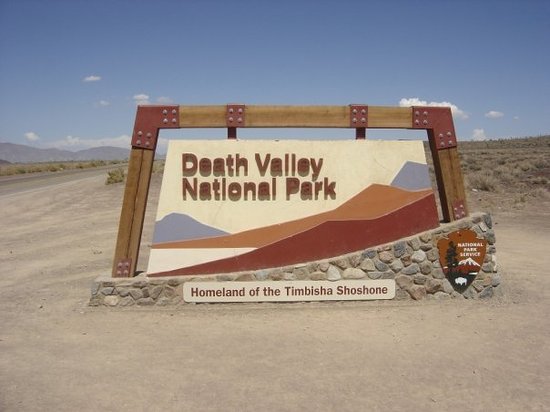
Death Valley National Park

In the second video we learn that Death Valley isn't dead, it's dormant. Underneath the surface there is potential. Ken Robinson gives us a tremendous amount of advice that can lead American schools out of the "Death Valley" they are currently in. The three things that are important for human flourishing are the keys to improving the culture of education. The first thing is we must remember that human beings are naturally different and diverse. Ken Robinson is quick to point out that No Child Left Behind (NCLB) is irony at it's best. Education under NCLB is based on conformity when it should be based on diversity. Students are diverse and they prosper best under a broad curriculum. The second thing that is important is curiosity. Our job as teachers is really easy if we can spark curiosity. Once curiosity is sparked children are natural learners. Great teachers mentor, stimulate, provoke, and engage their students. Ultimately, education is about learning. The whole point of being a teacher is getting students to learn. If our future students don't learn it's our fault. In our current culture, teachers are more concerned with test results than curiosity. Testing has a role in education, but it shouldn't dominate education. The infatuation with test results could be the biggest problem with our current system of education. The third key to human flourishing is creativity. Human life is inherently creative. Imagination and creativity is a unique trait of human beings. It's our role as educators to awaken these powers in our students. The problem is in our current culture of education students are becoming standardized. Everyone of us who will become teachers has the ability to change this culture of education. The question is do we care? If we do care about our students we will break away from the current system.

How Schools Kill Creativity

Creativity of the human mind

In the final video Ken Robinson discusses some issues he has with the current culture of education dealing with student's creativity. Robinson states that creativity is just as important as literacy. The problem is schools are instilling fear in students. Students are so afraid of being wrong that they get in a quite bubble. People who are afraid of being wrong will never come up with anything original. Children naturally aren't frightened of being wrong, but after years of schooling this capacity is diminished. We have to change this by creating an atmosphere where students can be who they are. Sir Ken Robinson also asks why certain subjects (like Math) are treated with higher regard than others (like dance). Not every student is going to be a college professor. Intelligence is diverse, dynamic, and distinct. In todays society a degree in a popular course of study doesn't equate to a job anymore. We must rethink the way we educate. We must consider the whole being of a student, not just certain areas.

Tuesday, November 5, 2013

Project #10 Interview

This is my interview with Justin McNellage of Saraland High. Justin is a first year teacher. He's currently teaching 9th and 10th grade English. He also does yearbook for Saraland.

Monday, November 4, 2013

C4K Summary for October

1st C4K

In my first C4K assignment of October I was assigned to Garrett's blog. Garrett is a student in Mr. Rhodus' sixth grade class. The title of his blog was How Much does the Sky Weigh? Garrett explained that the sky weighs 1 million billion pounds. He explained that air pressure doesn't crush us or push us down because the air moves evenly.

In my comment I introduced myself and provided a link to my blog, and the class blog as well. I explained to Garrett that he taught me something I didn't know. Garrett did a great job with his blog overall and I was glad to have the opportunity to comment on it.

2nd C4K

The second C4K I was assigned to in October was Mara Pickle's. In her blog post she revealed that she was excited about the current book she's reading in her class. She stated that she didn't want to stop reading. A fellow student even commented on it and they both shared the same excitement.

It was clear to see that Mara enjoyed blogging and reading. I introduced myself and explained that I love reading a good book as well. I told Mara to keep up the good work.

3rd C4K

In the 3rd C4K of October I commented on Vincenzo's blog post. He is a student in Mrs. Hartooni's class. In this blog post he was simply sharing a few interesting things that most people do not know. The first thing he shared was that fish have more water in them than humans do. The second thing that Vincenzo shared was that scientists are actually saying that it's healthier to not make up your bed.

In my comment to Vincenzo I introduced myself and included a link to my blog and our class blog. I explained to him that I did not know those things. I let him know that I was going to use what he shared as an excuse to not make up bed. Also, I let him know that he did a good job with his post and that he needs to keep up the good work.

4th C4K

In my fourth and final C4K of October I commented on a student's blog post who simply went by the handle of A. A's blog post was about their hero. A's hero was their mom. The student even compared their mother to a superhero.

In my comment I introduced myself and explained that I'm currently going to school to become a teacher. I told A that my mother was one of my hero's too. I told A to keep up the good work and to let his/her mother know that they are loved.

Sunday, November 3, 2013

C4T #3

Map of Arabian Peninsula

I was assigned to Hadley Ferguson for my 3rd set of C4T's. She teaches 7th and 8th grade History.

First Comment:

In my first post Ms. Ferguson explained that she had to rewrite a lesson plan due to her students not being as engaged as she hoped. She gave them freedom to do whatever they wanted in learning about life in the Arabian peninsula before Muhammed in 570 AD. She thought that they would be interested in this due to being in groups and having the freedom to use whatever tool they wanted to learn about the area. Surprisingly her first class simply did enough to get by. Ms. Ferguson was disappointed, but she took the responsibility on herself. She wasn't going to allow that disappointment to keep her from her job though. Instead of wallowing in her disappointment, Ms. Ferguson decided to change her plan. She had experienced this before in students and knew it was her responsibility to provide a good hook that would get her students engaged. She re-wrote her lesson plan and added a kick-off activity where she showed her students images of the Arabian peninsula and this did the trick.

In my comment I began by introducing myself. I provided a link to our class blog and my blog. I told Ms. Ferguson that I was currently learning about Project Based Learning. I let her know that I was impressed with her humility in taking responsibility for her students not getting hooked with her first lesson plan. I came away from her first blog post realizing that it's okay to make mistakes, mistakes provide an opportunity to learn.

Second Comment:

In the second blog post of Ms. Hadley Ferguson's that I commented on she was discussing a new book she had read titled Role Reversal: Achieving Uncommonly Excellent Results in the Student Centered Classroom by Mark Barnes. The book really had her addicted to being the best teacher she can be. She throughout her lesson plan because she knew she can make it better. She had started off the year with two great plans for her 7th and 8th grade classes. These plans would introduce Project Based Learning to her students. The problem arose when she moved on to her next plan, Ms. Hadley felt that she had became complacent. However, after reading Mark Barnes book she was addicted to being the best teacher she could be. She re-wrote her lesson plans that would connect the students to the material.

I was blown away by Ms. Ferguson's dedication to being the best she could be. In my comment I let her know that I was impressed with her work ethic. I now want to give Mark Barnes book a read. It can sometimes be hard to fight against complacency and any book that helps you fight against it is worth reading. I was encouraged by Ms. Ferguson and the way she showed that it's never too late to change your lesson plan or teaching methods. I'm thankful that I was assigned to Ms. Hadley Ferguson for my 3rd C4T's. I learned a lot from her.

Blog Post #11

Kathy Cassidy Summary

iPad on top of paper notebooks

The students in Kathy Cassidy's class are engaged in learning and it's due to the use of technology. Kathy uses a wide variety of technology from blogging to video gaming devices in the classroom. It's surprising because Kathy admits that she hasn't always been a technologically savvy person. In fact, Kathy just recently got a Facebook account. However, Kathy understands the importance of technology in the present world and states that technology isn't going away any time soon so we might as well use it. She is always learning new things and is open to applying these things in her classroom.

Ms. Cassidy teaches first grade and other elementary grade levels in Moose Port, Canada. At her school it seems like Kathy is a trail blazer in utilizing technology in the classroom. Since she's been at her current school she's had multiple principals, but none of them have hindered her from using technological tools in the classroom. Ms. Cassidy is proof that no one's going to hinder you from using technology in your classroom. She's had principals who weren't technologically savvy at all and they still gave her the freedom to teach her class the way she wants. This is encouraging to me, because I've feared facing opposition for using technology in my future classroom. One of her fellow teachers is intrigued, and has started to use technology in their classroom as well.

I would love to use all of Ms. Cassidy's techniques in my classroom, but the one that stuck out the most was the use of video game devices. Ms. Cassidy's class used the Nintendo DS to help learn reading, problem solving, and sharing. Since I started taking EDM 310 one tool that I've been wanting to apply in my classroom is video gaming. I believe that video games are fun and are an easy way to get students engaged. One concern of using video games would be making sure the students are playing age appropriate games, but as the teacher it will be my job to make sure they are. There are minor concerns with every technological tool, but the good far out ways the bad in most instances.

Another technique that I will make sure to use in my future class will be blogging. Ms. Cassidy makes a great point, students want to have an audience and blogging gives them that. Cheating could be a problem as the student pointed out in the final video, but Ms. Cassidy states that it's our job as the teacher to ask creative questions to prevent this. Kathy is clear to point out that there's nothing wrong with collaborating though. Collaborating is a part of life. We all learn from one another and that shouldn't be seen as a problem.

Overall, the interview was great. Ms. Kathy Cassidy is doing some great things with her students. I have come away acknowledging that I don't have an excuse to not use technology in my future classroom. Kathy is proof that if you don't make excuses you can learn new things and help students in all areas of life.

Sunday, October 27, 2013

Project #14 PBL Plan #2

Degas Group Project #14

Cartoon animated Congressional Bill
This lesson plan lasts for a week and is geared for high school students.  The driving questions for this project are How does Congress Work? What cause Filibusters? What do Congressional Bodies say about a Representative Republic? We will split the classroom into two groups, "House" and "Senate".  Legislative issues will then be given for the groups to debate and discuss.  Each group will elect a representative (Speaker of the House-House, Vice President-Senate) to present their position the group has reached. If the stances are mutual, the bill is passed, if not they start over.  Students will use iPads and laptops for research, and they may make a presentation that the leader will present.  

Sunday, October 20, 2013

Blog Post #9


Education in a "Meaningful and Motivational Context"

Written By: Degas
Erin Crane, Wesley Etheridge, and Lance Wilkinson

In his TED talks presentation, Brian Crosby expressed the idea that an education in a "meaningful and motivational context" was the right of every student in the educational system; to which he got a round of applause from the audience. As educators, this should be our goal; however, how do we achieve a "meaningful" and "motivational" context. What questions do we ask students? What projects do we engage students in? How do inspire students to carry what they've learned throughout their lives? 

AP Biology teacher Paul Anderson poses the power of the question. He implores the "Blended Learning Cycle" in his classroom. The Blended Learning Cycle is a combination of Blended Learning (incorporating elements of online, mobile, and classroom learning) and the Learning Cycle. The Learning Cycle is a process composed of the steps of engaging, exploring, explain, expanding, and evaluating. By applying the Blended Learning Cycle students are engaged in a meaningful and motivational context. Mr. Anderson uses the Blended Learning Cycle in his own classroom using a process he named "Quivers". The steps for "Quivers" include: "Ask a question", "Investigation, Inquiry", "Video", "Elaboration", "Review", "Summary". These steps engage students, applying a meaningful and motivational context to the classroom. 

Check out Mr. Anderson's Video on Blended Learning:


In a TED Talks Presentation, Brian Crosby gave a presentation entitled "Back to the Future" in which Mr. Crosby details his experiences working with at risk children. Mr. Crosby poses that striking a passion in students will remove the "disconnect" from education. Project Based Learning, Blogging, and Skype are all used by the students to further immerse them in learning. By doing so, the students are not only engaged in learning, but learn to collaborate and detail their findings in a meaningful context. By applying a meaningful context, students are further immersed in learning and thus, become much more passionate.

Mr. Crosby's Blog: http://learningismessy.com/blog/?p=854
Making Thinking VisibleMark Church, author of "Making Thinking Visible", shows that critical thinking can be applied, thus making it seem relevant in a meaningful context. Mr. Church had students make a "Headline" for "what the puzzle and challenge for search for human origins is all about". This may seem like a simple assignment, but as one student remarked: "That's a big topic to put in such a small amount of words." Students worked in groups, so all the students in the group had to agree on the Headline. This teaches students collaboration and critical thinking, inspiring discussions between students that are much more effective than lecture alone. 

Above all, these teachers show us that providing education in as Brian Crosby says, a "meaningful and motivational context" is most important. This context can be achieved through interactive learning, engaging projects, critical thinking, and discussions. This leaves us to conclude, in modern society, questioning might just be more important than answering. 

Sunday, October 13, 2013

C4T #2

Google Map of North America

First Comment: The teacher I was assigned to for my second C4T is Eric Langhorst. Eric teaches 8th grade Social Studies. The first blog post of his that I commented on was Missing Google Maps Classic. Eric explained his love for Google, but he goes on to discuss a recent change Google Maps has made that he doesn't like. The new Google Maps doesn't give you the ability to add as much content as they previously did and the user interface is now more difficult to use. The reason Eric is upset is because Google Maps is a tremendous tool he uses in his classroom. His 8th grade students are creating their own progressive Google Map as they move through the year. Each unit the students will add locations to their maps that are significant to their current unit.

In my comment I introduced myself and provided links to the class blog and my personal blog. I told Eric that at the time I was not familiar with the new Google Maps, but I was with the old version. I went on to explain to him that I had never imagined using Google Maps in the classroom, but thanks to his blog post I will definitely utilize it as a tool in my classroom. Although Eric was disappointed in the new Google Maps, it is still a valuable tool that can aid the learning process in a major way. Twitter logo

Second Comment: The second blog post by Eric that I commented on was titled As Seen This Week on Twitter....Sharing Twitter With Staff. Eric explained that he has recently started sharing some of his favorited tweets with his fellow teachers at school via email. The fellow teachers have been enjoying the links and Eric has found that teachers are more likely to "tip their toe in the Twitter stream if they see value in creating a PLN".

In my comment I responded by thanking Eric for the great links that he shared. The first link that caught my attention was, When Did Americans Lose Their British Accents? I learned about rhotacism. Another link that I'm extremely thankful he shared is The Role of Mistakes in the Classroom. The article made clear a terrifying truth, most students are so afraid of making mistakes that they're afraid to even try.

Blog Post #8

Degas Collaborative Post

21st Century Learning and Communicating Tools

Wesley's Part:

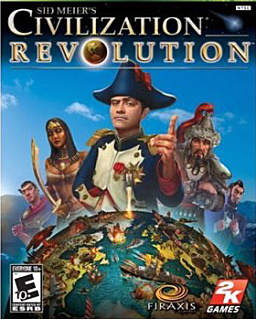
Civilization Revolution Video Game

I've learned about so many new tools in this class that I thought it would be impossible for me to find something new to add to my class, but I was wrong. I will be teaching Social Studies on the high school level so it's very important that the tools I utilize are age appropriate and engaging. After a lot of thinking and research, I've come across numerous technological tools that would be great for a history class. However, there are three that I want to discuss today that really stood out to me:
1) Sid Meier's civilization video game series
2) Google Maps
3) History Matters website

The first tool is probably my favorite tool. In some of my previous blog posts I've discussed how I believe some video games are a tool that history teachers can use to their advantage. Sid Meier's Civilization video games specialize in historical content. These games are available on the iPad, Computers, and gaming consoles. In my classroom I plan to use the iPad version of this game. The game is a turn-based strategy game series in which you attempt to build an empire to stand the test of time. Students will have the opportunity to become ruler of the world by establishing and leading a civilization from the dawn of man into the space age. They will be able to wage war against other civilizations on the game, conduct diplomacy, discover new technologies for their civilization, go head-to-head with some of history's greatest leaders, and build the most powerful empire the world has ever known. The game's instructions are very clear, and allow anyone over the age of 10 great gameplay. This game would be great to utilize when teaching World History because it allows you the opportunity to play as any of the early world empires. It would give students a better understanding of these early civilizations and would even allow them to see how technological advancements have taken place over time. The game could be a great tool if used properly.

The second tool is one that I never thought about using in my class until I was assigned to Eric Langhorst's blog for C4T's. Eric is a social studies teacher and he has used Google Maps to aid in teaching his 8th graders about geography. Google Maps allows you to learn about the geography of every where in the world. It's truly amazing. I can remember the first time I ever found out about google maps. I would get lost looking at various places all over the world zooming in as close as I could to see what it was like there. Eric Langhorst allowed his 8th grade class to create their own progressive Google Map in his class and I would love to do something like this myself. Each unit the students add locations to their map that are significant to the content they are currently studying.

The third and final tool I want to share is a website that provides numerous resources for history teachers. History Matters provides teachers with various links, but the thing I like about this website the most is it connects history teachers with other history teachers. This is a great way for me to shape my teaching strategies with other history teachers. Also, this tool provides over 1000 links to historical documents, images, and audio interviews.

Lance's Part:

By "pre-loading" the material to be taught before the lecture, students could gain a general knowledge of the material and ask questions, leaving the class time to be devoted to applying the material, rather than being delivered the material. This application is extremely valuable to all subjects, but as a future History teacher I see enormous potential in the process of receiving and learning material before class to inspire questions, speculation, and debate.
3 Sources I have found to apply this method are:
1) ITunes U
2) Online Websites: Roy Rosenzweig Center for History and New Media, Fordham University's Internet History Sourcebook, and BBC History.
3) Databases (Such as the Alabama Virtual Library - AVL)

ITunes U provides an immense resource for students of any academic discipline. ITunes U allows students to subscribe to Podcasts of areas of study as well as provides Primary and Secondary Sources for humanities subjects. Since most students own an iDevice of some sort, most students could take their classroom material with them to access at any time. ITunes U is full of material that can be incorporated into any curriculum.
Man listening to iTunes

The internet provides an immense amount of content, but students need to know how to filter content to get the best sources possible. The teacher as a guide should show students where to access proper source material online first, to give students a good example of what fits good source criteria. From there, students can find their own websites and resources for source material. Being able to filter content is a 21st century skill directly related to the study of History. The Roy Rosenzweig Center for History and New Media is a website that provides an immense amount of content directly related to the field of History. Students can browse everything from broad categories such as surveys of U.S. History and World History, to specific topics such as Women in History, and Events/Time Periods such as The French Revolution. Take a look: http://chnm.gmu.edu/teaching-and-learning/
Fordham University in New York also provides an "Internet Sourcebook" for History Students. Primary Sources from all of History are provided online for research and study. These primary sources will be assigned in class in context of the curriculum and Common Core Standards. In addition, the Primary Sources Fordham University's website provides can be used for Research Papers and Presentations. Fordham University Link: http://www.fordham.edu/Halsall/mod/modsbook.asp
BBC History Online also provides has a less-detailed source catalogue, as well as Historical games and quizzes for areas of interest. BBC History: http://www.bbc.co.uk/history/interactive/games/

Students can also access source material online at The Alabama Virtual Library, or AVL. The AVL provides a secure, academic database for students to use for research. The internet is an excellent tool for preserving the past, but looking toward the future. Using technology students learn not only to gather information, but to filter information as well. By applying 21st century skills to the classroom, students can engage in research like never before. Having sources directly available via the internet connects students to a world of knowledge no one before our time could imagine.

Erin's Part:

In this class we tend to talk about things that relate more to Elementary Education. Don't get me wrong, I still find new things to incorporate in my classroom. For this blog assignment I wanted to get outside of the things we have learned and find something that would interest my high school students, particular in my history classes. Usually any tool you find for history of that age involved a lot of reading simply because of the content. I visited some of my favorite historical landmarks' websites to see if they had anything interesting. Here's what I found.

Mount Vernon

Mount Vernon is one of my favorite historical places i've visited. The grounds are gorgeous and there is so much history there with the birth of our nation. I would love to be able to take my students there, but it's just not always financial feasible. I started looking at their website and noticed this page.

They have a Teacher Resources section of their website that included Lesson Plans you can use as well as videos you can incorporate into your teaching. They also have a photo/video gallery of things around the estate that I could show the class as I am teaching. They also have a Student Resources section.

I can send my students here for research when they are completing their "This Person In History" project (see lesson plans). This section holds more videos, an interactive "Meet people from the past", and a digital encyclopedia.

fter finding these new tools I could use successfully I decided to go look at some of my other favorite historical places' websites. Ford's Theatre has a Virtual Tour that I could pull up to use as a point-of-view when talking about President Lincoln's assassination. The U.S Capitol also has Teacher and Student Resources that I could turn to when discussing the more political aspects of history.

I feel like students would have more fun navigating the sites themselves, and it even may spark an interest for them to go search out more historical websites. The virtual tours would help them visualize things more clearly, as well as the videos. Overall, I think using this tool and technology might help high school students become more interesting in the history of their country.

Project #9

Degas Podcast

Sunday, October 6, 2013

C4K summary for September

C4K Summary

1st C4K

In my first C4K I was assigned to a female student who went by the username of Buck. The title of Buck's blog post was "This I Believe". Buck's blog post was about tattoos. She believes that tattoos are a great way you can express yourself through art. She also went into detail about a few of her tattoos and how important they are to her. Her first tattoo was in memory of her dad who passed away in 2010. Her dad was someone who she was extremely close to and she wanted to have something that reminded her of all the great memories she shared with him. Her second tattoo was one of the nickname her brother had given her. Her second tattoo was significant to her because her brother has been incarcerated for the past four years and she wanted him to know that she's always thinking of him.

In my comment I introduced myself and included a link to my blog, and the EDM 310 class blog. I explained to Buck that I also have tattoos, and that I think tattoos are a great way to express yourself. I wanted to stress the fact that tattoos are permanent, so I made sure to explain that I believe it's important to think long and hard before you get something permanent like a tattoo. However, so far Buck seems to have two tattoos that will always be significant to her. Buck had a few grammatical errors, but overall she did a great job of sharing her passion for tattoos.

2nd C4K

In my second C4K I was assigned to blogger by the name of Ebony. Ebony's post was very short and was actually in response to a fellow classmate by the name of Maggie. Maggie had made a post about cyber bullying and Ebony stressed that she was saddened that one of her friends had been cyber bullied on FaceBook. Ebony explained that she believes many people think they're "cool" when they bully others, but she stated that in reality they're not cool at all.

In my response to Ebony's blog post I introduced myself and provided a link to my blog, as well as a link to the class blog. I wanted to make sure Ebony knew that she was noble and correct in her stance against bullying. I stressed the importance of being friends with anyone who is a victim of bullying. Also, I told her that if she ever witnesses someone being bullied in school that she reports it to her teacher. If she witnessed bullying outside of school I encouraged her to tell a parent.

Ebony did a great job with her blog post and I concluded my comment by letting her know that.

3rd C4K

In my final C4K for the month of September I was assigned to a 5th year student who went by the name of Dartanian. Dartanian is from Auckland, New Zealand. Dartanian's blog post was simply uploading a picture of the math crossword puzzle they did in class. Dartanian and a fellow classmate by the name of Toma worked together to do the math crossword puzzle.

Dartanian's blog post was impressive to me, because his blog set up was creative and bright. Also, I was impressed with the way Dartanian scanned his crossword puzzle to the blog. I made sure to tell Dartanian to keep up the good work and I let him/her know that the layout was very creative.

Overall

Overall, I enjoyed my C4K's for the month of September. It's humbling, yet encouraging, to see younger students be successful in blogging. I hope my comments made a positive impact on the students I was assigned to.

Project #2 PLN 1st Progress Report


I've learned a lot about my Personal Learning Network through this project. As a teacher I'm going to constantly be learning new things from my peers. Also, as a history teacher I will constantly learn new things from historians. I like the idea of playing the role of a detective and asking questions. I hope to constantly take advantage of networking with fellow educators. Having the technological advancements we have today allows me to collaborate and network with educators from all over the world. I will never know everything, but social media will provide me with a way to connect and learn from people who are far smarter than me. It's a relief to know that I will have a network that I can rely on for support.

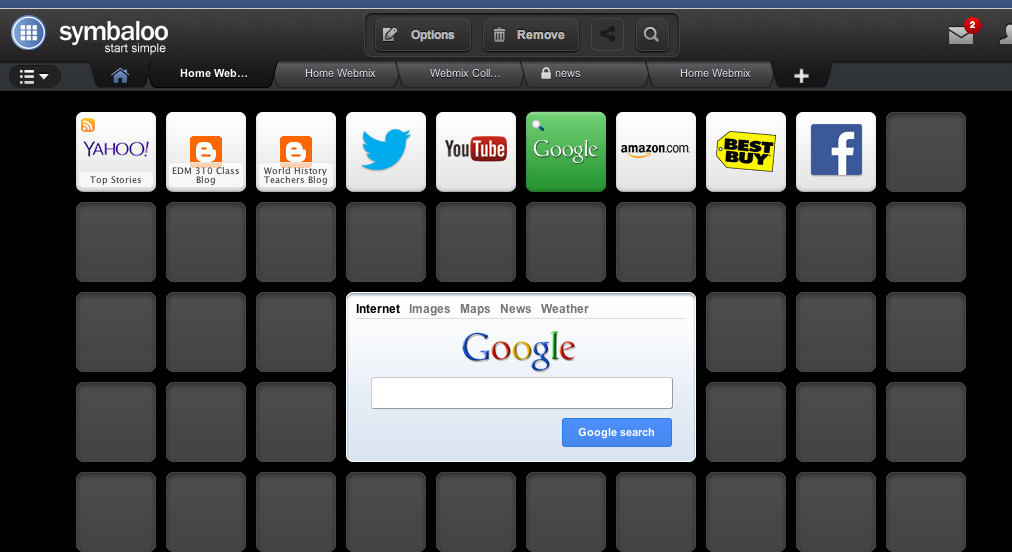
I chose to use Symbaloo over Netvibes due to liking the Symbaloo layout better than the Netvibes layout. Currently I only have 9 of the 60 tiles occupied. I have Twitter and Facebook tiles, but Twitter is currently my favorite social media. I'm already following Dr. Strange and other EDM 310 staff, but I've also been able to follow a few historical accounts on Twitter that always provide interesting links relating to history. Facebook is also important to me due to being friends with some past teachers that left great impressions on me. Following and/or becoming friends with these teachers on social media has allowed me access to the multiple great links they're always sharing. The EDM 310 class blog also made a tile on my page, because there are just so many resources and links provided through the class blog site. I also made a tile for Dr. Ken Halla's blog site. He was the first teacher I was assigned to in C4T's and he's always sharing great things on his blog. Overall, I am extremely pleased with my progress in developing a PLN. At the top I have included a picture of my tile's.

Blog Post #7

Dr. Strange and Anthony Capps
What Can You Learn From These Conversations With Anthony Capps?

Degas Response

In the 21st century, more professionals in the field of education are seeing the impact Project Based Learning can have on the educational process. According to Anthony Capps in his discussions with Dr. Strange, Project Based Learning can reach its apex when the students authentically receive the project. This authenticity can be achieved by capturing student interest.

In the video discussion, Mr. Capps encouraged Project Based Learning through an assignment for his 3rd Grade students to write a letter to Congressman Joe Bonner. What is most interesting, as well as unconventional, is that Mr. Capps encouraged the students to peer edit each others’ writing and then choose themselves which eight were the best. This is collaboration at its finest because it was the students selecting which letters were the best and not the teacher. There seems to be something very Democratic about Project Based Learning.

Project Based Learning also exercises practical ACCRS and Common Core standards. In their letters to Joe Bonner, Mr. Capps’ students were actually practicing extremely relevant reading and writing skills.

Mr. Capps also encouraged the use of Icurio due to its mass amount of content. In addition, Icurio is a search engine for a mass amount of Filtered Media. This makes Icurio an ideal safe engine for students to use. Icurio is perfect to be in used in conjunction with Project Based Learning because it provides a safe place for students to research and gather material for their projects. Discover Education works very much in the same way, but focuses on digital mediums of learning rather than research.

Overall, the video discussions between Mr. Capps and Dr. Strange prove that students desire an interactive learning environment. More so, when teachers give students an interactive environment, the students become more involved than ever. An interactive and engaging learning environment starts with interactivity, Project Based Learning, and an availability of the tools necessary to achieve these new methods of Education such as Icurio and Discovery Ed.

Based on these 4 videos
Part 1
Part 2
Part 3: iCurio
Part 4: Discovery Ed

Wesley Etheridge: "Additional Thought About Lessons"

In the video, Additional Thought About Lesson, Anthony Capps explains that a lesson is 4 layers thick. The first "layer" of developing a lesson is thinking about how the lesson fits into your plan in terms of the entire year. This requires deciding if you are going to cover all of your content standards, and then writing out a curriculum map that ensures all of the standards are covered during the course of the year. The next layer is the unit. According to Anthony Capps it is vital that the unit is planned in a cohesive manor that ensures each unit sets up the next. This assures that you don't force students to learn everything about one particular unit in one day. Rather than forcing students to learn everything in a short amount of time, you plan a certain point in time where the students should be able to master the outcome. The third layer, so to speak, is planning your week. This entails having a goal for each week, and asking yourself what will you do each day to achieve that goal at weeks end. The fourth and final layer is the daily plan. The daily plan is how you engage students on a daily basis. Anthony says you start with a hook that gets the students engaged and then by the end of the day you use something to actually measure what they have discovered. You then take those measurements to plan your next day. Anthony Capps is clear to point out that it doesn't matter which layer you start with, but all four layers are equally important in having a successful lesson.

In this short video I learned a lot about a lesson. I agree with Anthony that all four layers are important, but the part that grabbed my attention the most was his comment on the importance of having a hook that engages students on the daily level. I would love to hear him discuss examples of hooks in the future with Dr. Strange.

Erin Crane: "Strange List of Tips for Teachers"

In the video, The Anthony-Strange Tips for Teachers, Anthony Capps and Dr. John Strange gave tips for beginning teachers to remember. Anthony, a former EDM 310 student and well respected third grade teacher, and Dr. Strange imparted six “tips of wisdom” (as I like to call it) upon those who watched the video. The list consisted of:
1. Be interested in learning.
2. Be ready to put in the hard work.
3. Be flexible with the way you teach.
4. Always start with a goal.
5. Engage your students 100% of the time.
6. Reflect,revise, share, and work with an audience.

A couple of these seemed like common sense advice, but it hit me that I hadn’t really thought of it. I have always been a believer in the “you get as much effort as you put in” method so I understood the hard work tip. The first piece of advice given, be interested in learning, put me at ease. I’ve always had a fear of not remembering or knowing enough information to teach my students, but I realize I will have to teach myself new curriculum every day. History is something that doesn’t change, but at the same time is constantly changing. Everyday a new event will happen that I can compare to a past event in history, hence, “history repeats itself”. As I get older I also realize my students may also start teaching me things, which is fine, it means they’re learning! Another tip I liked was to be flexible with the way you teach. I realize every class is different from the next, and some things I use in one I won’t be able to use in the others. Having a plan set out is great, but I need to learn to be flexible to roll with whatever happens. We may get on a topic the kids have a lot of questions about, and I won’t cover the rest of my lesson plans for the day. I’ll have to make that up at some point in the week. Flexibility is a great word for teachers to remember, as well as the tips given to us in this video.

Lance Wilkinson: "Don't Teach Technology, Use It"

The video conversation between Anthony Capps and Dr. Strange “Don’t Teach Technology, Use It” focuses on the opinion that students should be familiarized and learn to apply technology through Project Based Learning. This belief is founded on the fact that technology will become immensely more prevalent during our future students’ lives, therefore technology should be a medium of the learning process.

According to Mr. Capps, technology is advantageous to learning because it is clean and sharable. A huge part of education, as well as technology is sharing. Therefore it would make sense that the two be combined. Technology also excites students and makes educational material seem more relevant to their daily lives.

By applying technology to Project Based Learning, students not only learn the material, but also become more familiar with technology through the project. Implementing technology into the classroom through Project Based Learning also teaches students problem solving skills. In addition, technology should be implemented gradually to familiarize students with technological mediums in order to build week by week on technological familiarity.

The main thesis of the video rests on having students engage in Project Based Learning by applying technology, rather than merely teaching technological applications to students. In this way students can apply what they’ve learned in the project’s subject and familiarize themselves with technology in an interactive and engaging learning process.

Project #13 Project Based Learning Plan #1

Lesson Plan #1 Created By Wesley Etheridge for Project #13

This lesson plan adresses objectives 9.3.1 and 9.3.2 of the Alabama State Objectives. The focus of the lesson plan is the Reformation and what caused it. Also, students will have a better understanding of the influence the Reformation has on the world today. This lesson plan is for students in the 9th grade taking World History: 1500 to the Present. It covers a period of 5 days.

Sunday, September 29, 2013

Blog Post #6

The Office Character: Dwight Schrute

Asking Questions

As a learner it is mandatory to ask questions. As a future teacher that means it is vital that I continue to improve my understanding of questioning. Ben Johnson's article is humbling, yet encouraging. It reiterates to me that it's okay to step off my high horse, so to speak, and realize that I will not know everything when I teach. The good news is that throughout life I will continue to learn new things, and when a student proposes a question that I don't know it's a great opportunity to learn.

The article by Ben confirms that the way we present questions and answers can be detrimental to students. Ben Johnson states, "...sometimes the students do not understand that they do not understand, and if they do not know what they do not know, there is no way they can ask a question about it." This statement is true, and it's terrifying how many teachers don't care. Even today in college I experience classroom settings where only a select few students are involved in asking questions. There are multiple techniques that can be used as a solution, but the website Ben linked in his article provided some fantastic resources teachers can use.

Ultimately the goal of asking questions is to get the students engaged. The Three Ways To Ask Better Questions in The Classroom article by Maryellen Weimer provides 3 easy methods you can apply to improve the question's you ask your students. First she suggest actually taking the time to prepare the specific questions you will ask your students. Teachers are quick to prepare their lesson plan or lecture, but for some odd reason they don't think twice about preparing specific questions to ask. Taking the extra time to prepare specific questions will assure that the questions you ask are clear and easy to understand.

The second method Maryellen suggests is to play with questions. Playing with the question means leaving the question unanswered for a while rather than quickly telling the students if they're right or wrong. This keeps the students pondering. I can personally remember this method being used by a few of my favorite teachers and I can remember it being successful in keeping students engaged.

The final advice she gives is to preserve good questions. If you ask a question that really seems to get the students engaged it would be wise to write it down. You can even use the responses you receive to tweak your questions, or add to your questions. The most important aspect of this technique is it can get the discussion at least started if your students are having a hard time to answer a question.

All three of the techniques Maryellen Weimer provided are great ways to get students engaged, but my favorite is the first. Taking extra time to prepare specific questions is simple, it just requires a little bit of time and effort. I do believe I will implement all three of the suggestions Maryellen provided though. This was a great read for me mainly because of how easy it is to implement all three of these methods into my teaching.

The key is getting students engaged in the process of asking questions. A learner is a questioner by nature. There is nothing more important to learning than questioning. It's vital I make sure my students are engaged and actually learn rather than just memorize material. As a future history teacher there isn't anything more important than the way I ask questions.

Project #8 : Book Trailer

Sunday, September 15, 2013

Project #3 Presentation

Blog Post #4

Podcast
Why Podcast? How do we do a Podcast?

I've never really thought about how podcasts could be used in the classroom, but after this assignment I feel like it's mandatory that I utilize this in my classroom. In the Langwitches blogpost, 1st Graders Create Their Own Read-Along Audiobook, it gives a great example of how to get student's involved in the classroom by making their own audiobook. The teachers recorded the students reading, and also they recorded the script so the students could read along. The students got so involved through this method that they even wanted to re-record their voice when they didn't like they way they sounded. The recordings also lead the first grade student's to experiment with garageband. It impresses me that by combining the printed scripts with the audiobook the students followed along with their fingers. The student's learned reading skills, writing skills, and on top of those two they learned how to utilize technology.

The second Langwitches blog I read, Flat Stanley Podcast, continued to show the amazing benefits of using podcasts with a class. One of the first grade classes at Silvia Tolisano's school read the book Flat Stanley, by Jim Brown, and sent their own versions of Flat Stanley to their relatives and friends around the country and received images and stories back. The book is about a young boy named Stanley who get's flattened by a gift bulletin board his dad gives him. Stanley utilizes his flattened state by being mailed in an envelope to visit his friends.

The students were inspired by their fellow class that made the audiobook for the Magic Tree House and wanted to make their own recording for their version of Flat Stanley. The class had to brainstorm a storyline so that every student could have a segment. The students also had to choose a location they wanted to be mailed to, and they had to use the internet and library books to research the location they chose. The student's weren't spoon fed information by the teacher, instead they took the initiative and did the learning on their own. Brainstorming with fellow classmates will be vital for every student when they get into their profession and this assignment did a tremendous job of preparing them for that.

The third blog I chose to summarize was the Benefits of Podcasting in the Classroom by Joe Dale. The first thing to note is that podcasts provide a way of interacting with your students outside of the classroom. This is important because there is a limited amount of time you have with your students in the classroom, and podcasts can be listened to at any time and anywhere. Podcasts are also something students in this generation are familiar with due to the popularity of apple products like iPads, iPhones, and MacBooks. If I wanted to include visual effects I could do a vodcast, which is simply a podcast with video. Another benefit of using podcasts is that when students are out due to illness they will still have access to the lecture material from class. One of my favorite benefits would be the ability to put my podcasts into my blogs when I begin teaching. The benefits of podcasting are numerous and there aren't any negatives so I believe it's a no brainer that podcasting is something we as educators need to utilize.

C4T #1

Flipped Classroom http://ushistoryeducatorblog.blogspot.com/2013/08/how-to-start-your-students-on-flipped.html

The teacher I was assigned to is Ken Halla. First Comment: In the first blog I read Ken blogged about flipping a classroom and explained what a flipped classroom meant. Apparently he and two other teachers have embraced and taught others about "flipping". He shared a video in which a teacher named Frank Franz discussed what it means to flip a classroom. Flipping is basically doing the opposite of what a lot of classrooms do. Instead of doing homework at home and lectures in the classroom you flip it. This gives the teacher more one on one time with the students in the classroom. The students have access to the lectures online at all times. The grading is a bit different as well, it utilizes standards based grading to assure that the student is ready for the next grade level.

In my comment I introduced myself and told Ken Halla how interesting the concept of a "flipped classroom" was to me. I told him that a flipped classroom would be something I would consider implementing in my classroom when I become a teacher. Also, I told him how much I like the Standards Based Grading. Using formative assessments as practice for the summative assessments was my favorite part, because it makes sure the students learn on their own.

Google Maps http://ushistoryeducatorblog.blogspot.com/2013/09/putting-us-in-perspective.html

Second Comment: In the second post I commented on Ken's blog titled Putting the US in Perspective. This blog contained a link to one of Ken Halla's former colleagues named Matt Mough. The link revealed how inaccurate the size of countries are proportioned on most maps. The link compared the accurate size of other various countries compared to the accurate size of the US.

In my comment on this post I explained to Ken that I was a victim of the misrepresentation of our country. I also noted that I did not realize how large the continent of Africa really was. The video in the link explained that map makers do this because size equates to power for most. I explained that I do often equate the size of a country or continent to power. I also let Ken Halla know that it is always a pleasure to read his blogs.

Sunday, September 1, 2013

Blog Assignment #2

Snoopy Dancing

Wesley Etheridge, Erin Crane, and Lance Wilkinson: Professor Dance-a-lot

The video on Professor Dance-a-lot reflects the sentiment of “burp-back education”. Professor Dance-a-lot merely showed the students how to do something by lecture, when it would have been much more effective to have them engage themselves. The students didn’t really learn how to dance, because they never had to try. The point of the video is that in the future of the education we want to engage the students, not merely lecture at them. In this way teachers and students will both become more effective learners and leaders.


Wesley Etheridge: Teaching in the 21st Century

Kevin Roberts made it clear that teachers in the 21st century will have to stop simply providing content, dates, facts, and formula’s. Teachers are no longer the source of information; instead we are the filter between the students and information they have access to learn on their own. Roberts nailed this point by listing all the things students can use to learn on their own. Resources such as blogs, Google, cell phones, Twitter, Wikipedia, and YouTube are available to the majority of students in America.


What does it mean to be a filter? Kevin Roberts asks the question, “How do we teach students to handle their resources?” Being a filter means that we show our students how to use the resources made available to them. Teachers in the 21st century must show students how to validate, synthesize, leverage, communicate, and collaborate information. Roberts poses another important question, with all of this information available should our curriculum be focused on facts and content, or skills? If students can learn facts on their own, it’s clear we should focus on the skills needed.


I honestly don’t disagree with anything Kevin Roberts stated. I think he’s correct, and I think it means we need to focus on engaging students rather than entertaining students. Engaging students begins with the teacher. As teachers we need make sure we’re doing anything it takes to keep our students engaged at all times. Rather it be through collaborating with fellow students or utilizing questions that challenge students to solve problems online, the focus needs to be on engaging students. If Roberts is correct the challenge for me will be to take risks. Instead of making assumptions that my students won’t be successful learning facts on their own, I want to try different methods and see what happens.


Erin Crane: Harness Your Students’ Digital Smarts 

Edutopia, an educational sources website, has a video detailing Vickie Davis’ unique way of using media tools to connect her students to learning.  Vickie is an innovative teacher in Camilla, Georgia that has taken it upon herself to use games, blogs, wikis, and virtual worlds to ignite a want in her students.  Mrs. Davis herself has won an award for best teacher blog in the world.  She has traveled around the country talking about the techniques she is using but her passion remains in the classroom with her students.  As a “teacherpreneur” she has taught her students new software, to learn how to learn, how to use the Wiki, and how to collaborate with other students more effectively.


Mrs. Davis has collaborated with Julie Lindsey, a teacher in Qatar, to form a global collaborative project they named Digi Teen.  Students all over the globe have come together studying digital citizenship by researching and posting their finding through two digital portals!  Along with Digi Teen the two teachers have also founded another project.  Flat Classroom Project is a project that lets students experience trends in information technology by writing reports with other students and creating videos.  She has even travelled with some of her students to the Middle East for a conference for the Flat Classroom Project.  Vickie Davis made a statement at the end of the video that stuck with me.  She said, “I believe this whole idea of turning school upside down and empowering students to share with one another.  If you can empower them you are just going to have a better classroom.”


Lance Wilkinson: The Networked Student

The educational theory and practice known as Connectivism puts emphasis on networking and interactive learning rather than on traditional educational mediums , lecture and readings. The Networked Student video (created by Wendy Drexler) also puts emphasis on the role of technology in the future of the educational field. The Thesis of the video claims that Connectivism is the way of the future for education. Furthermore, the video reassesses the role of the teacher as a guide for the learning process.


The example student in the video was shown to have taken very well to Connectivism. The student networked with other students studying his subject of interest, subscribed to Podcasts to watch classes around the world, and started blogging to discuss subjectively his area of interests with other students, as well as muse on his subject in his personal blog. It is argued in the video that this is the way of the future for education. The student only went to class three days a week and didn’t even have a book!


Connectivism will definitely be a major aspect of the educational field in the future. What a wonderful resource the internet and technology are! However, putting too much emphasis on networking can either take away or dramatically add to the academic discipline being studied. The video assumes every student will do what is necessary to be a self-learner and take the time and effort to network. In the school system today, some students refuse to even do short reading assignments. Therefore it is impossible to assume every student will actively participate in Connectivism. However, this should not dissuade anyone from the value of Connectivism. I believe the ideal is to continue our push towards Connectivism without completely throwing off lecture and readings. In this way students will both learn from valuable resources (books, academic articles, journals), and network what they’ve learned online; making Connectivism even more valuable. Students could refer each other to academic sources and books that they’ve read and discuss themes or ideas from these reading assignments. 


The video asked: “In the future, why even have a teacher?”. The video argues that the teachers role is to be a guide for networking. This is a crucial element of our educational system because networking is such a major part of our modern society. I believe the teachers role is to actively participate in the learning process by lecturing and assigning relevant readings, but also to encourage networking and Connectivism. In this way our future students will be competent, educated, networking individuals.


Sunday, August 25, 2013

Blog Assignment #1

What I Want My Students To Know

I feel somewhat enlightened after learning about Krissy Venosdale and Sugata Mitra. I must admit that I feel like a victim of being spoon fed information through a lot of my schooling rather than learning on my own. The blog Krissy wrote about her dream school immediately made me start to ponder what my dream school would look like. "The Innovation Zone" would be amazing, and if it actually existed I wouldn't mind going through school all over again. The idea of changing grade levels from age based to readiness and ability really intrigues me because human beings are not robots who are all the same. Every student is different, and some may be ready to move on to advanced subject matter quicker than others. Reading Krissy Venosdale's ideas on Venspired helped me to dream the dream so to speak, but I was still skeptical of it being successful. Then I watched Sugata Mitra's video. The Hole in the Wall experiments gave me evidence that Krissy's dream school would be successful. I see why Sugata Mitra won the 2013 TED prize.

What I Want My Student's To Be Able To Do

As a future teacher I can imagine my classroom and I can't deny a sense of fear that comes over me. Not the fear that I won't be knowledgable of the History classes I teach at the high school level, but a fear that I will teach the way I was commonly taught through high school. We all know the saying, "History tends to repeat itself" and I hope I don't repeat the same mistakes my teachers did. However, the good news is I am taking Dr. Strange's class and I believe what I learn this semester will break me from the norm of today's teaching. As simple as it sounds, I want my student's to be able to learn!

What Do I Want My Students To Know?

I don't want my student's to just learn history, I want them to be fascinated by it. I want them to have the passion where as when they learn something new they keep digging deeper for more. I'm not bashing science or other subjects, but some things we have to learn from history. We can't do a scientific experiment to learn if the Civil War took place. Many times we have to rely on historical knowledge to learn and I hope my student's will see the importance of that.

What Do I Want My Students To Be Able To Do?

I want my students to be able to ask questions about the past and find answers. It's impossible to know everything, because often times we don't get everyone who was involved's view of the story when it comes to history, but with all the resources we have thanks to technology my students will be able to know as much as possible. With iPads and internet access they'll be able to do all the research themselves and see as many view points of the story as possible.

What Will Be My Primary Method Of Teaching My Students What I Want Them To Know And To Do?

My primary method is to get students passionate and interested in the subject matter. If I can get my students to see the importance of the subject matter for themselves the battle will be won. Letting students get together and learn hands on together seems to show promise. Sugata Mitra's experiments are evidence that having peers learn together is more successful than individual learning. I can personally remember learning a lot in group projects and I will utilize groups for my classroom.

What Tools Will I Use In My Classroom?

The greatest tool I can use in my classroom would honestly be technology. Digital interactive books, websites, and applications on the iPad all come to mind. This may surprise some people, but video games could be a tremendous asset in the field of History. A great example would be the game series Assasin's Creed. The latest game, Assasin's Creed III, put's you into the shoes of a Native American assassin who witnesses the birth of America. The game designers did a tremendous job of being historically accurate and you encounter famous people such as George Washington, Benjamin Franklin, and Samuel Adams throughout the game. War video games also come to mind. It would be important to make sure the video games are age appropriate, but I have no doubt it could be a great asset in getting student's interested in History.

What Role Will Students Play In My Classroom?

Students will play the most important role in my classroom. They will be just as successful as I at doing the "teaching" after attending my class. I can't stress enough how enthused I feel about having student's learn together in my classroom. The Hole in the Wall experiments by Sugata Mitra convicted me of the importance of learning with peers.